Stage 01
Egg: a carefully chosen beginning
Most female butterflies place eggs on or near a particular host plant. The choice matters: after hatching, the larva must find suitable food quickly. Eggs range from smooth spheres to ribbed domes and may be laid singly or in groups.
Host selection
Receptors on the legs and antennae help a female evaluate plant chemistry and condition.
Development
Temperature, moisture, and species biology influence the time from laying to hatching.
Stage 02
Caterpillar: built to eat and grow
The larva’s main work is feeding. As its body expands, the outer skin cannot stretch indefinitely, so the caterpillar molts. The growth periods between molts are called instars. Camouflage, hairs, spines, eyespots, and warning colors provide different kinds of defense.
- Hatch: some larvae first consume part of the eggshell.
- Feed: host plants provide the material and energy for growth.
- Molt: a roomier exoskeleton forms beneath the old skin.
- Prepare: the mature larva finds a suitable pupation site.
Stage 03
Chrysalis: transformation within
When fully grown, the caterpillar anchors itself and forms a pupa. A butterfly pupa is commonly called a chrysalis. Inside, tissues are reorganized while adult structures—including wings, compound eyes, legs, reproductive anatomy, and a proboscis—develop.
A chrysalis is living tissue, exchanging gases and responding to temperature and light. Its color and shape may blend into stems, leaves, bark, or dry plant material.
Stage 04
Adult: emergence, flight, and renewal
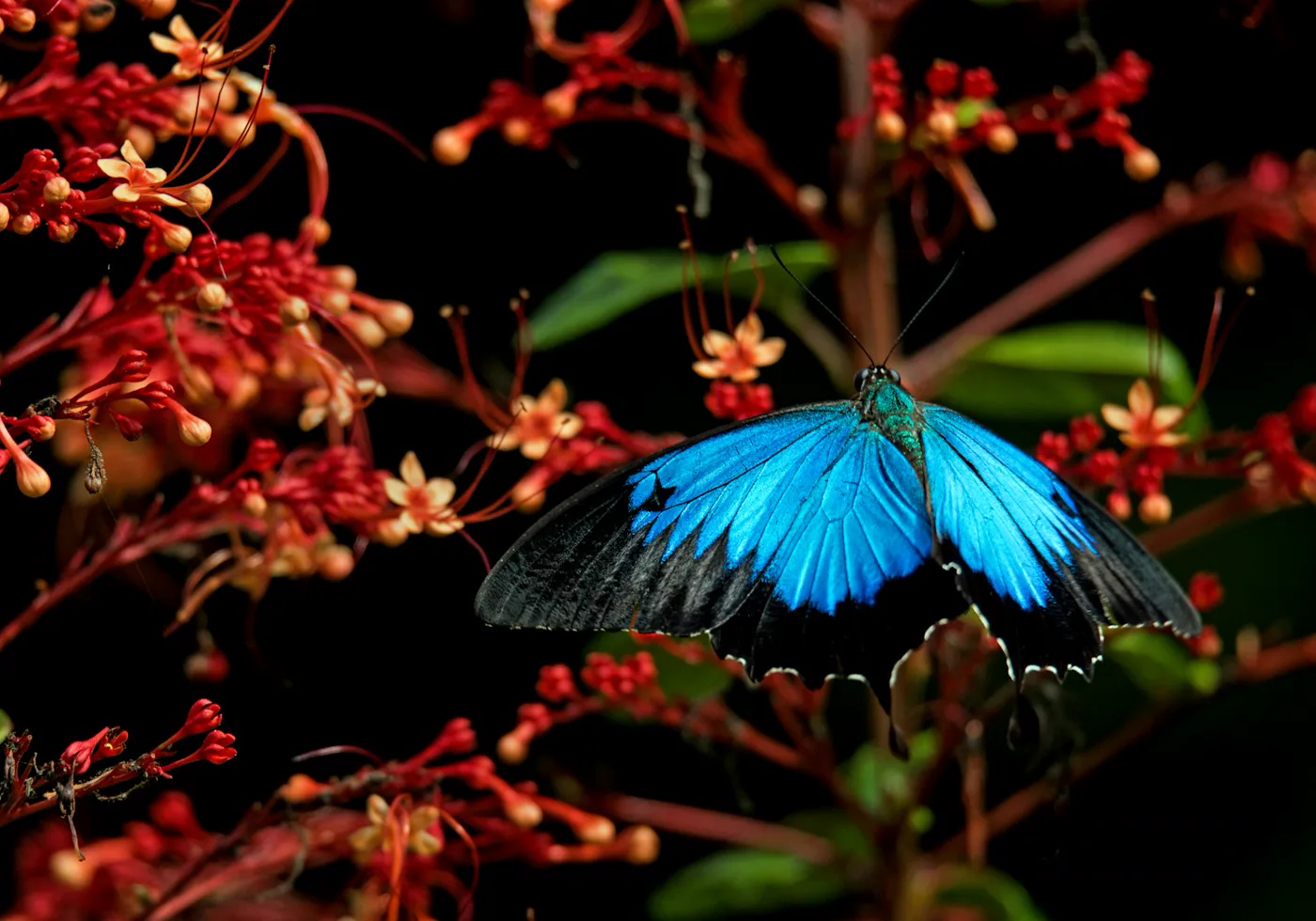
At emergence, the wings are soft and folded. Fluid pumped through the veins expands them; the butterfly then waits as the wing surfaces harden. Adults seek energy-rich liquids, mates, shelter, and suitable places for the next generation.
Feeding
Nectar, fruit, sap, and mineral-rich moisture support different adult species.
Reproduction
Courtship, mating, dispersal, and host-plant selection begin the cycle again.
Across the year
Seasonal cycles and waiting
Not every generation moves through the four stages at the same speed. A species may pause development as an egg, larva, pupa, or adult during cold, dry, or otherwise unfavorable conditions. This programmed dormancy is called diapause.
One generation
Some species synchronize a single annual generation with a brief host-plant season.
Several generations
Others produce multiple generations when warmth and food remain available.
The science
What complete metamorphosis means
Butterflies are holometabolous insects: a feeding larva and winged adult are separated by a pupal stage. Because larva and adult often use different foods and spaces, the two stages reduce direct competition with each other.
Hormones coordinate the sequence. Juvenile hormone helps maintain larval form; changing hormone levels and timed pulses of ecdysteroids help initiate molts, pupation, and adult development.
Close relatives
Butterfly and moth life cycles
| Feature | Butterflies | Moths |
|---|---|---|
| Stages | Egg, larva, pupa, adult | The same four stages |
| Pupa | Often an exposed chrysalis | May be enclosed in a silk cocoon, though not always |
| Adult activity | Many are active by day | Many are active at night, with many exceptions |
| Antennae | Usually club-tipped | Often feathery or tapered, with exceptions |
Field glossary
Terms of transformation
Instar
A larval growth interval between two molts.
Host plant
A plant that provides food for the caterpillar.
Pupa
The stage between larva and adult; in butterflies, commonly called a chrysalis.
Eclosion
The emergence of an adult from the pupal case.
Diapause
A regulated pause that helps survive an unfavorable season.
Holometabolous
Developing through egg, larva, pupa, and adult stages.
Related examples
Monarch larvae specialize on milkweed. Many swallowtails use particular aromatic plant families. Painted Ladies are unusually flexible, using numerous host plants and producing successive generations across wide regions.
Compare species field recordsFrequently asked
Questions about metamorphosis
How long does the complete cycle take?
It varies widely with species, season, food, and temperature—from a few weeks to many months when a dormant stage pauses development.
Does a caterpillar know it will become a butterfly?
“Knowing” is not a useful biological description here. Hormones and genes coordinate feeding, molting, pupation, and adult development.
Can a butterfly grow after emerging?
No. The adult exoskeleton does not grow. A newly emerged butterfly expands its wings, but its basic adult size is fixed.
Should I help a butterfly out of a chrysalis?
Usually not. The emergence process supports normal wing expansion, and handling can cause permanent damage.